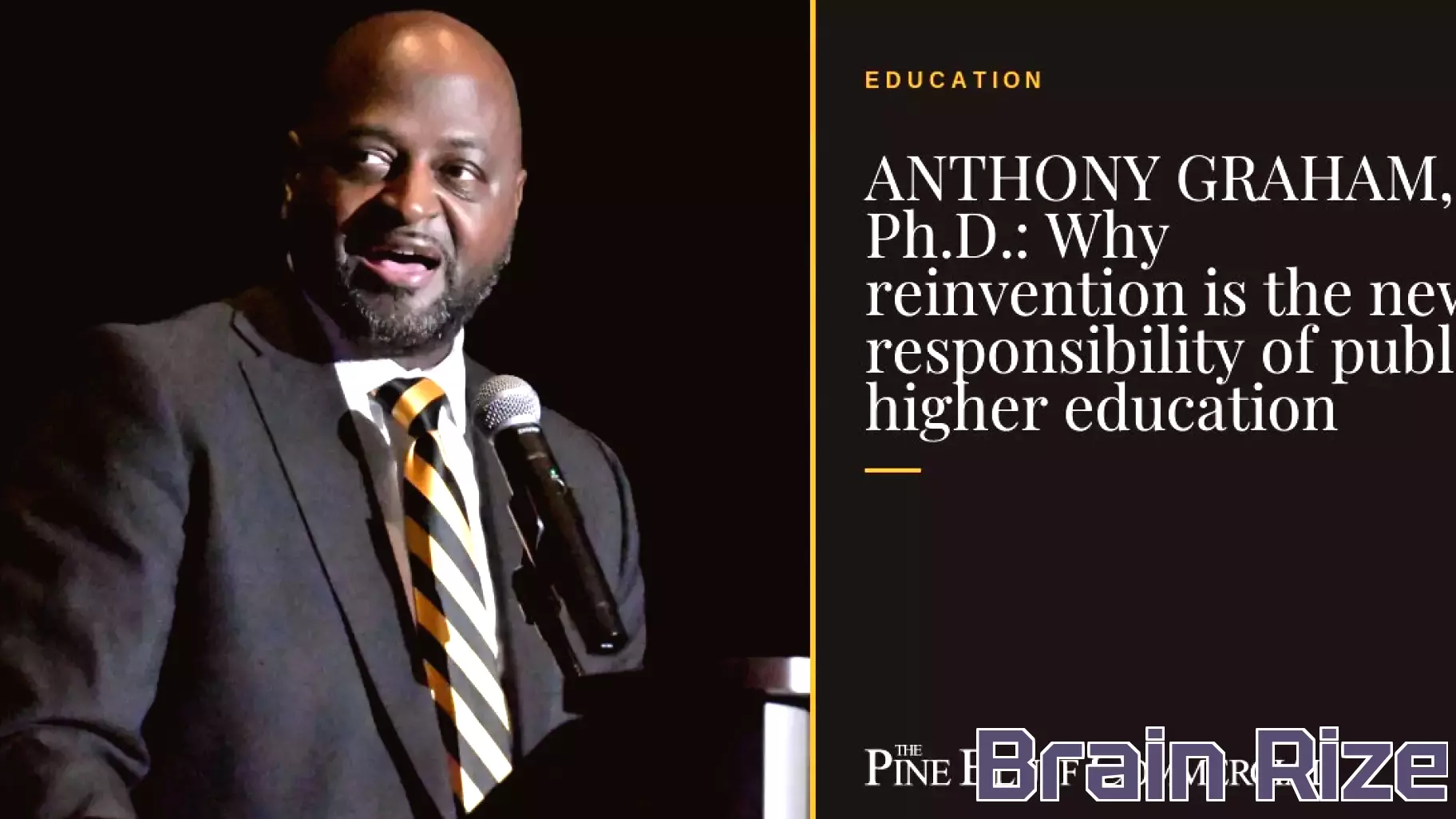
ANTHONY GRAHAM, Ph.D.: Why reinvention is the new responsibility of public higher education
August 2, 2026 - 04:18
Leadership scholars have long observed that every system is perfectly designed to produce the results it produces. This simple observation carries profound implications for higher education. If our universities are producing outcomes that no longer meet the needs of today's students, employers, and communities, the answer cannot be to simply work harder within the same outdated structures. The real challenge is reinvention.
For decades, the core model of the university has remained largely unchanged: fixed semesters, lecture halls, and a degree that signals completion after four years of seat time. Yet the world around it has shifted dramatically. Students are older, more diverse, and more likely to work while studying. Employers increasingly value specific skills over general credentials. And the cost of a traditional degree has climbed to a point where many families question its return on investment.
Public higher education, in particular, carries a unique responsibility. It is the primary engine of social mobility, the training ground for the state's workforce, and a anchor for regional economic development. When that engine sputters, the consequences are felt far beyond the campus gates. Communities lose their talent pipeline, industries struggle to fill critical roles, and the promise of a better life for the next generation weakens.
Reinvention does not mean abandoning the liberal arts or the deep research that defines a university. It means rethinking delivery, structure, and purpose. It means offering micro-credentials that stack toward degrees, embracing competency-based learning that measures mastery rather than time, and building partnerships with local industries to ensure curricula stay relevant. It means meeting students where they are, both physically and digitally, and removing the bureaucratic barriers that keep them from finishing.
The institutions that will thrive are those that treat their own transformation as a core part of their mission. They will not wait for external pressure to force change. They will lead it. The responsibility is clear: adapt, or become irrelevant. The time for incremental tweaks is over. The time for bold redesign is now.
MORE NEWS
September 15, 2026 - 23:03
Missouri Board Rejects Push for Full School Funding IncreaseThe Missouri State Board of Education declined Tuesday to seek the roughly $300 million increase needed to fully fund the state`s public school funding formula. The decision means the board will...
September 15, 2026 - 02:40
Teaching Scholarship Shows Results After Seven YearsAfter seven years, the Underwood Smith Teaching Scholarship is starting to produce educators for West Virginia. Lawmakers received an update on the program, which was created to address persistent...

September 14, 2026 - 02:20
Ministry of Education Opens Scholarship Applications for Egypt and MoroccoAmman, Sept 13 - The Directorate of Scholarships and Cultural Offices at the Ministry of Education has announced the availability of scholarships in Egypt and Morocco for the current academic year....
September 13, 2026 - 06:30
Jefferson Township Schools Add 20 New Staff Members for the Fall TermJefferson Township schools have welcomed 20 new staff members this fall, filling a range of roles across the district. The group includes classroom teachers, counselors, a social worker and several...